If you are asking whether you have outgrown your IT provider, the answer usually appears…
What Is a Service-Level Agreement (SLA) in Managed IT?
Updated: 6/5/2026
When you choose a managed IT provider, you look for more than technical skills. You seek accountability and peace of mind. A managed IT service-level agreement (SLA) serves as the foundation for this relationship. It defines expectations, sets clear boundaries, and ensures your technology partner remains focused on your success.
In today’s fast-paced market, IT downtime costs businesses more than ever before. Recent research published on May 12, 2026, highlights that the average cost of IT downtime for small businesses now ranges between $8,200 and $25,600 per hour. Consequently, a vague promise of “we will fix it soon” is no longer sufficient. You need a formal, legally binding commitment that protects your operations from prolonged disruptions.
At Terminal B, we view the SLA as a strategic tool rather than a mere document. We integrate our proactive Skytivity model and our status as a Microsoft Security Solution Partner to deliver stability that outpaces standard industry benchmarks. This guide explains why the right SLA is the secret to scaling your organization with confidence.
What is a Managed IT Service-Level Agreement?
A managed IT service-level agreement is a formal contract between your organization and your IT provider. It outlines the specific services you receive and the performance standards the provider must meet. This document ensures that both parties understand their responsibilities. It eliminates the guesswork that often leads to frustration during a technical crisis.
More Than Just a Support Ticket
An SLA covers various critical areas including response times, resolution targets, and uptime guarantees. It specifies exactly what happens when a server fails or when an employee cannot access their email. Without this agreement, you have no baseline to measure the quality of your managed IT services. Furthermore, an SLA provides a roadmap for escalation. It tells you exactly who is responsible for your problem and how quickly they must act.
Why an SLA is Your Best Safeguard Against Modern Threats
Modern business environments face constant pressure from cyber threats and strict regulatory requirements. Consequently, your SLA must evolve into a legal and operational safeguard. It is not just about fixing a broken printer anymore. It is about protecting your data and maintaining compliance with industry standards.
Compliance and Regulated Industries (HIPAA, Finance)
For organizations in healthcare or finance, an SLA is a mandatory component of risk management. Our SLAs at Terminal B include specific commitments for HIPAA and NIST compliance. We provide detailed reporting that proves your systems meet necessary security thresholds. If you operate in a high-stakes industry, your provider must commit to rapid incident response and thorough documentation. This level of transparency helps you pass audits and avoid heavy fines. You can learn more about how we support these sectors on our healthcare IT consulting page.
The Skytivity Difference: Proactive Prevention Over Reactive Response
Many providers wait for something to break before they take action. This reactive cycle keeps your business in a state of constant vulnerability. Terminal B uses the Skytivity model to break this cycle. We focus on proactive monitoring and maintenance to identify issues before they impact your productivity.
Our goal is to beat our own SLA response times. By preventing a system failure, we ensure you never have to open a “Critical” ticket in the first place. This proactive approach turns your IT from a source of stress into a driver of growth. When we stop a threat at the perimeter, your team stays focused on their core tasks. As a result, your business maintains high efficiency regardless of external digital trends.
The Microsoft Security Solution Partner Advantage
Cloud services are now the backbone of the modern office. However, managing these environments requires specialized expertise. Terminal B is a Microsoft Security Solution Partner. This designation is vital for your organization because it provides us with direct access to Microsoft support tiers.
If a critical cloud issue arises, we do not wait in a general queue. We leverage our direct relationship to get answers and resolutions faster than a standard middleman could. Your SLA is effectively backed by the weight of Microsoft’s own engineering teams. This advantage is crucial for businesses relying on Azure or Microsoft 365. Whether you are dealing with a complex configuration or a platform-wide glitch, our partnership ensures your business remains online.
Key Components of a High-Performance SLA
A high-quality SLA should be transparent and easy to understand. You should look for several core components when reviewing an agreement for IT support in Austin or across Texas.
Response Time vs. Resolution Time
Many people confuse these two metrics, but they serve different purposes.
- Response Time: This is the duration between when you submit a ticket and when a technician begins working on it.
- Resolution Time: This is the time it takes to fully solve the problem and restore normal service.
A good SLA provides targets for both. For example, a “Critical” issue might have a 15-minute response time and a 2-hour resolution target. This structure ensures your provider stays focused on the outcome, not just the acknowledgment.
Uptime Guarantees and Support Scope
Uptime guarantees commit the provider to keeping your systems available for a specific percentage of the time. We typically aim for 99.9% uptime for business-critical infrastructure. Additionally, the scope defines exactly which devices and users are covered. This clarity prevents unexpected “out-of-scope” charges that can wreck your IT budget. For businesses looking for a managed service provider in Texas, having a local partner who understands your specific operational needs is a significant benefit.
A Real-World Example of Tiered SLA Response
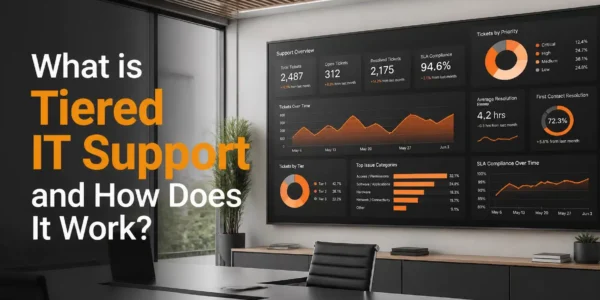
We use a tiered system to prioritize support. This ensures that a total network outage always takes precedence over a minor software update. Here is a simplified look at how a professional SLA organizes priority levels.
By following this structure, we provide a predictable environment for your employees. They know exactly when to expect help. Consequently, your management team can plan effectively without worrying about hidden technical delays.
Maximize Your IT Investment
An SLA is not just a safety net. It is a tool for accountability that drives your provider to perform at their best. When you partner with Terminal B, you gain a team that is committed to your long-term stability. We combine local expertise with global partnerships to deliver the best managed IT services in the region.
Are you ready to secure your business with a proactive IT strategy? We invite you to schedule a strategy session with our team. We will review your current infrastructure and show you how a customized SLA can transform your operations.
Contact Terminal B today for a comprehensive IT strategy session
Frequently Asked Questions
What happens if a managed IT provider misses an SLA target?
If a provider misses a target, a high-quality SLA usually includes “service credits” or a formal review process. At Terminal B, we use missed targets as a learning opportunity. We conduct a root-cause analysis to ensure the issue does not happen again. Our transparent reporting ensures you always see our actual performance metrics.
Does an SLA cover cybersecurity incidents?
Yes, modern SLAs should include specific response times for security events. As a Microsoft Security Solution Partner, we prioritize security alerts through our Skytivity model. We treat potential breaches with the highest level of urgency to mitigate risk and protect your data.
Is a custom SLA better than a standard one?
A custom SLA is often better for mid-sized organizations with unique compliance needs. While a standard SLA provides a great baseline, customization allows us to align our response times with your most critical business processes. For example, a construction firm might need faster support for their ERP system than for general office software.
How often should we review our service-level agreement?
You should review your SLA at least once a year. Your business grows and your technology needs change. An annual review ensures that the agreement still supports your current goals. It also allows you to adjust the scope as you add new employees or move more services to the cloud.
About Greg Bibeau
Greg Bibeau is the Founder and CEO of Terminal B. With 3 decades of experience in the information technology industry, he has guided hundreds of organizations through complex digital transformations. Under his leadership, Terminal B has become the premiere MSP in Central Texas, known for its proactive Skytivity model and commitment to client success.
Related Posts