Construction companies face IT challenges in construction industry because their work happens across offices, jobsites,…
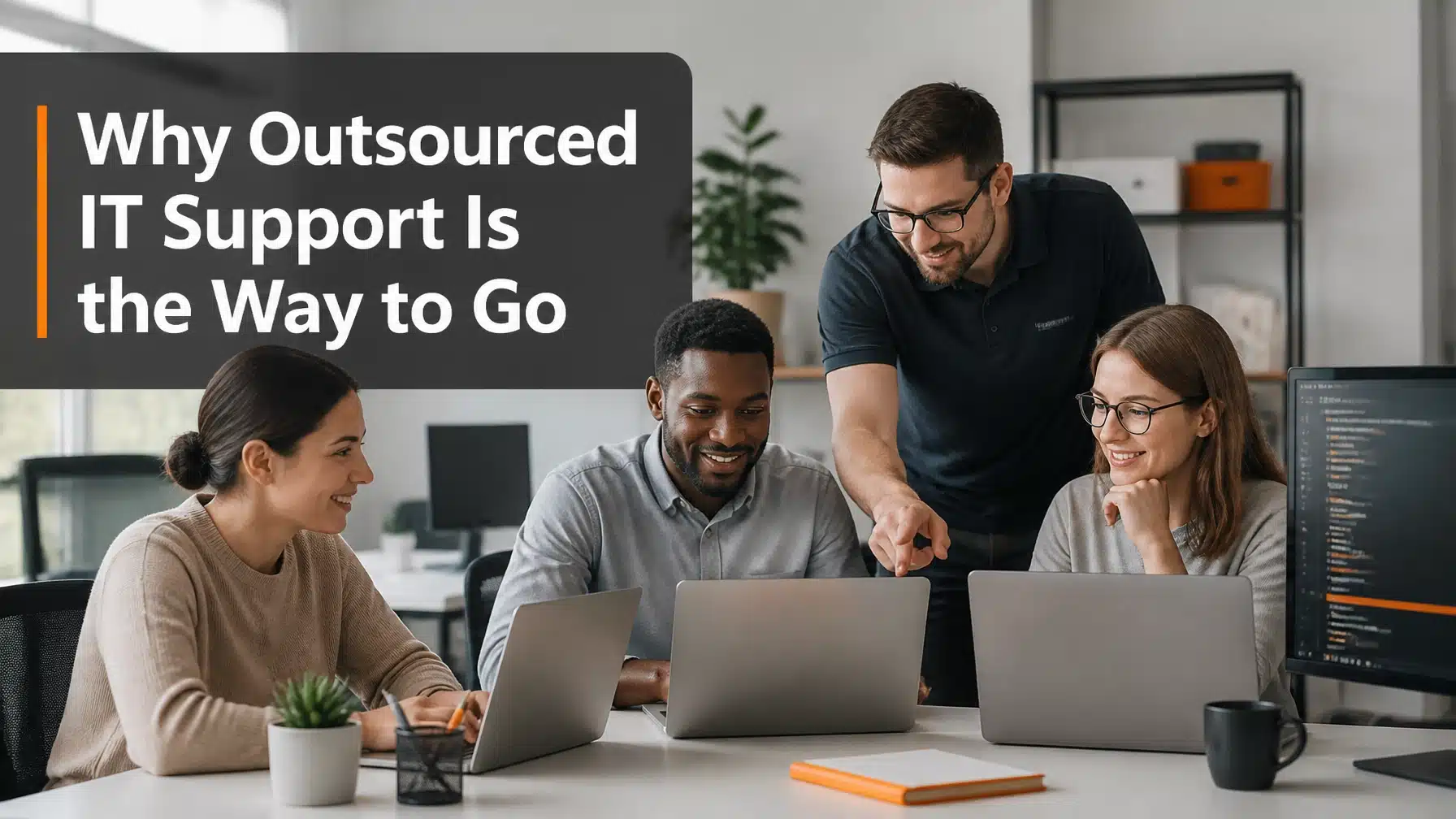
Why Outsourced IT Support Is the Way to Go: A Guide for Businesses
Updated: 6/3/2026
Running a modern business without high performing technology is like trying to win a race while wearing lead boots. You might move forward eventually. However, your competitors will likely zoom past you while you’re still trying to figure out why the printer is jammed again. Many organizations find themselves at a crossroads when choosing between hiring a full time technician or leveraging outsourced IT support.
Deciding to move your technology management to an external partner is a strategic shift. According to recent research by Information Services Group (ISG), enterprises achieve an average of 15% cost savings when they move away from in-house operations to specialized providers. In many cases, specialized Managed IT Service Providers (MSPs) help organizations reduce IT related expenses by 15% to 45% while simultaneously improving service quality by over 11%. This quick answer explains why so many Texas businesses are ditching the traditional “office IT guy” for a more robust, proactive model.
As a Microsoft Security Solution Partner, Terminal B understands that your technology should be a growth engine. It should not be a source of constant frustration. In this guide, we will explore why outsourcing your IT department is the most logical choice for scaling businesses. We will look at everything from AI productivity to Microsoft Azure scaling.
The Great Debate: In-House vs. Outsourced IT Department
Many business owners assume that having a person in a physical office is the safest bet for their tech needs. They like the idea of walking down the hall to ask a question. However, this model often creates more problems than it solves. An in-house IT department is frequently a “department of one.” This person becomes a single point of failure for the entire company.
Why Reliability Matters for Small Teams
Small and mid-sized businesses rarely have room for downtime. If your lone IT employee is out sick, in a meeting, or buried in a firewall issue, the rest of your staff keeps waiting. That delay hurts productivity fast. It also creates frustration across your organization.
A single internal technician may know your environment well. Still, one person cannot cover help desk tickets, cloud projects, security reviews, vendor calls, and long-term planning at the same time. So even simple requests pile up. Over time, that backlog slows growth and makes technology feel like a burden instead of an advantage.
The Hidden Costs of In-House Teams
When you hire a full time IT employee, you aren’t just paying a salary. You are also responsible for benefits, taxes, office space, and ongoing training. Technology moves at a blistering pace. As a result, keeping one employee current on cybersecurity services and cloud trends gets expensive fast. If that person gets sick or goes on vacation, your technical support essentially vanishes.
Just as important, one person cannot be an expert in everything. They may be great at fixing laptops but struggle with complex Microsoft Azure migrations. In other cases, they may understand basic networking but lack the deep expertise needed for advanced cybersecurity threat hunting. This talent gap often leads to technical debt that eventually hinders your ability to grow.
The All-In Advantage of Outsourcing
When you choose outsourced IT support, you aren’t just hiring a person. You are hiring an entire team of specialists. You gain access to a deep bench of talent that includes cloud architects, security analysts, and help desk pros. Together, they keep your systems operational 24/7.
In addition, an outsourced partner brings a level of process maturity that is hard to replicate internally. Most providers use enterprise grade tools for monitoring and management. So they often fix problems before you even realize they exist. That proactive approach is the hallmark of a high quality outsourced it department.

The Financial Blueprint: Why You Save More Than You Think
Let’s talk about the money. Most businesses switch to managed IT services because they want to save on their bottom line. The 15% to 45% savings range mentioned earlier is not just a marketing number. It comes from the elimination of overhead and the implementation of efficient systems.
Moving from Capital Expenses to Operational Savings
One of the biggest financial wins is the move from CapEx to OpEx. Traditional IT involves massive upfront costs for servers and hardware. An outsourced model, by contrast, focuses on predictable monthly operating expenses. This makes budgeting much easier for your finance team. You no longer have to worry about a sudden server failure wrecking your quarterly projections.
That shift matters even more for companies in healthcare, finance, and manufacturing. Those organizations often need secure devices, backup systems, compliance tools, and user support all at once. Buying everything outright ties up cash. A managed model spreads those costs into a more stable operating rhythm, which gives leadership more flexibility.
Why Flat-Fee Support Changes the Math
At Terminal B, we use a flat-fee model called Skytivity. This model aligns our incentives with yours. If your technology breaks, we have to work harder. So we stay highly motivated to keep your systems running well. That is a much better arrangement than the old “break-fix” model where providers only made money when your business was suffering.
Flat-fee support also gives you clearer planning. Your leaders can forecast IT spending with less guesswork. Your staff can get help without worrying that every ticket creates another invoice. As a result, IT becomes easier to budget, easier to manage, and easier to scale.
Leveraging AI and Agentic AI for Maximum Productivity
The current tech landscape is being rewritten by artificial intelligence. If your IT team isn’t thinking about AI, you are already falling behind. Outsourced IT support providers are at the forefront of this shift. We help businesses integrate tools like Microsoft Copilot to automate routine work and reduce manual effort.
Recent studies from Microsoft suggest that AI tools can boost developer productivity by as much as 55%. For general knowledge workers, the gains are often in the 20% to 30% range. However, implementing AI isn’t as simple as clicking a button. It requires a secure foundation, strong data governance, and a clear strategy.
Traditional AI usually responds to a prompt and then stops. You ask it a question, it gives you an answer, and a person takes the next step. That is useful for drafting emails, summarizing notes, or helping employees find information faster. Still, it is mostly reactive. It waits for human direction each time.
Agentic AI works differently. It can plan, take action, check results, and continue through a multi-step task with less hand-holding. In simple terms, traditional AI helps your team think faster. Agentic AI helps your systems do more work from start to finish. That difference matters when your organization wants automation that spans departments, apps, and workflows.
For example, a traditional AI tool might summarize an invoice email and suggest the next action. An agentic system could read the message, validate the sender, extract the purchase data, update a line-of-business app, open a ticket for approval, and notify the right manager. In a healthcare setting, that same model could help route intake paperwork to the right team while keeping an audit trail. In finance, it could support exception handling and document review under strict access controls.
That said, agentic systems need guardrails. They need identity controls, logging, data classification, and approval workflows. They also need the right integrations so they do not touch sensitive systems without oversight. So the value is real, but so is the risk if a business rushes ahead without structure.
This is where outsourced IT support brings practical value. An experienced provider helps you decide where AI should assist people and where agentic workflows can safely automate real tasks. We look at user permissions, Microsoft 365 data access, endpoint security, and business process design before anything goes live. As a result, your organization gains productivity without creating a new security problem.
Scaling Without Growing Pains via Microsoft Azure
Growth is the goal for almost every business we meet in Austin. However, growth often breaks technology. If you add twenty employees next month, can your current server handle the load? If you open a second location, how will they access your data?
This is where Microsoft Azure shines. As a Microsoft Security Solution Partner, we use Azure to build scalable, resilient infrastructures. Cloud computing lets you scale resources up or down based on actual demand. You only pay for what you use.
Building a Flexible Azure Foundation
Azure is not just one service. It is a full cloud platform with tools for compute, storage, identity, backup, networking, and security. That matters because most growing businesses do not need a single fix. They need a connected environment that supports users, protects data, and handles change without constant rebuilds.
For example, Azure Virtual Machines can support legacy business apps that still need a server environment. Azure Files can centralize shared data for teams in multiple offices. Azure Backup and Site Recovery can protect critical systems and speed up recovery after an outage. Plus, Microsoft Entra ID helps manage access so the right people can reach the right systems from the right devices.
How Azure Virtual Desktop Supports Growth
One of the most useful services for scaling businesses is Azure Virtual Desktop. This platform lets your team securely access a full Windows desktop and business applications from almost anywhere. That is especially helpful for hybrid teams, seasonal staffing, contractors, and organizations with multiple locations.
Imagine a construction company with project managers in the field, accounting staff in the office, and outside consultants who need limited access to plans and schedules. Azure Virtual Desktop can deliver a consistent workspace to each user without exposing your whole network. In healthcare, it can support secure access for administrative teams handling scheduling and billing. In finance, it can give employees a standardized environment with tighter control over data movement and local device use.
Azure Virtual Desktop also helps when onboarding has to move fast. Instead of shipping and configuring fully loaded workstations for every new hire, your IT team can provision access to a cloud-hosted desktop. So employees can get to work faster, and your organization keeps tighter control over applications, patches, and data.
Why Outsourced Azure Management Matters
Outsourced IT providers specialize in these cloud migrations and optimization projects. We ensure that your move to the cloud is seamless and secure. We also handle the heavy lifting of backend infrastructure management, identity controls, security baselines, and performance tuning.
That support matters after migration too. Azure environments need ongoing cost review, rightsizing, backup testing, policy enforcement, and access management. Without that discipline, cloud sprawl can creep in and erase the benefits of migration. With the right partner, your Azure environment stays efficient and secure as your organization grows. This scalability is a core reason why outsourced it support is the way to go for modern firms.

Bridging the Talent Gap in Cybersecurity and AI
The labor market for technical talent is incredibly tight. There is a massive global shortage of cybersecurity professionals. Consequently, finding and keeping a top tier security expert is nearly impossible for a small to mid-sized business. You simply cannot compete with the salaries offered by massive tech conglomerates.
When you outsource, you bypass this talent gap entirely. You get access to specialized cybersecurity services without the astronomical salary requirements. Your MSP becomes your Chief Information Security Officer (CISO). They stay awake at night worrying about the latest ransomware threats so you don’t have to.
Also, an outsourced team brings experience from many different environments. They see patterns across their entire client base. If a new virus hits a company in another city, your provider can proactively patch your systems before it reaches you. This collective intelligence is something an isolated in-house team simply cannot match.
Industry-Specific Solutions: Beyond Generic IT Support
Every industry has its own unique set of challenges and regulations. A generic “one size fits all” approach to IT usually fails. This is why specialized it consulting services are so valuable.
Healthcare and HIPAA Compliance
In the healthcare world, data security is a legal requirement. A single data breach can lead to massive fines and a destroyed reputation. Outsourced providers with healthcare expertise understand the nuances of HIPAA compliance. They ensure that patient data is encrypted and that access is strictly controlled.
Construction and Field-Ready Tech
Construction firms need technology that works in the field. They need to share massive blueprints and project files across remote sites. An outsourced partner can set up secure mobile solutions. They ensure that your team on the ground has the same access as the team in the office.
Financial Services and Precision Security
Financial firms are prime targets for cybercriminals. They require layered security and rigorous audit trails. We provide advanced cybersecurity services that meet the strict standards of the financial industry. This includes multi factor authentication and zero trust architectures.

The Skytivity Difference: Why Flat-Fee Managed IT Services Win
At Terminal B, we believe in simplicity. We call our proactive approach Skytivity. It is a flat-fee subscription model that covers all your essential IT needs. This includes our Skytivity Secure Help Desk, which provides 24/7/365 support for your employees.
This model is the ultimate expression of why outsourced it support works. We aren’t looking for ways to bill you more hours. Instead, we are looking for ways to make your IT so stable that you never have to call us. We invest in high quality monitoring and automated maintenance. As a result, your business runs smoother and your employees are more productive.
Conclusion: Start Your Strategy Session
Technology is moving too fast for you to manage it alone. The cost savings, the access to specialized talent, and the ability to leverage AI make outsourcing the obvious choice. You deserve a partner who understands your business goals. You need a team that acts as a true extension of your organization.
Stop struggling with “good enough” IT. It is time to embrace a model that drives growth and provides true peace of mind. Whether you need it support Austin or global cloud management, we are here to help.
Ready to simplify your technology? Contact Terminal B today for a strategy session. Let’s talk about how our outsourced it support can take your business to the next level.
Frequently Asked Questions
Is outsourced IT support more expensive than hiring in-house?
Generally, no. When you account for salary, benefits, taxes, and training, an in-house employee usually costs significantly more than a managed services contract. Also, an MSP provides an entire team of experts rather than a single person. Most businesses see a 15% to 45% reduction in overall IT costs after outsourcing.
How do I know my data is safe with an external provider?
A reputable MSP like Terminal B uses enterprise grade security tools and follows strict compliance frameworks like NIST and HIPAA. As a Microsoft Security Solution Partner, we implement layered defenses including EDR, MFA, and continuous monitoring. We often provide a higher level of security than an in-house team could afford to maintain.
Can an outsourced provider handle my industry-specific software?
Yes. Professional it consulting services involve learning your specific workflow and software stack. Whether you use specialized EHR systems in healthcare or CAD software in construction, we have the expertise to support and optimize those tools.
What happens if I have an emergency in the middle of the night?
Our Skytivity Secure Help Desk is available 24/7/365. You are never left waiting for an “office IT guy” to wake up and check his email. We provide immediate technical support for Windows and Mac environments whenever your employees need it.
About the Author: Greg Bibeau
Greg Bibeau is the Founder and CEO of Terminal B. With over 3 decades of experience in the IT industry, Greg has helped hundreds of businesses navigate the complexities of digital transformation. He is a passionate advocate for proactive IT management and believes that technology should be a seamless utility that empowers business growth. Under his leadership, Terminal B has become a leading Microsoft Security Solution Partner in Texas.
Related Posts