Manufacturers prevent manufacturing IT downtime by connecting proactive IT management with plant-floor resilience. That approach…
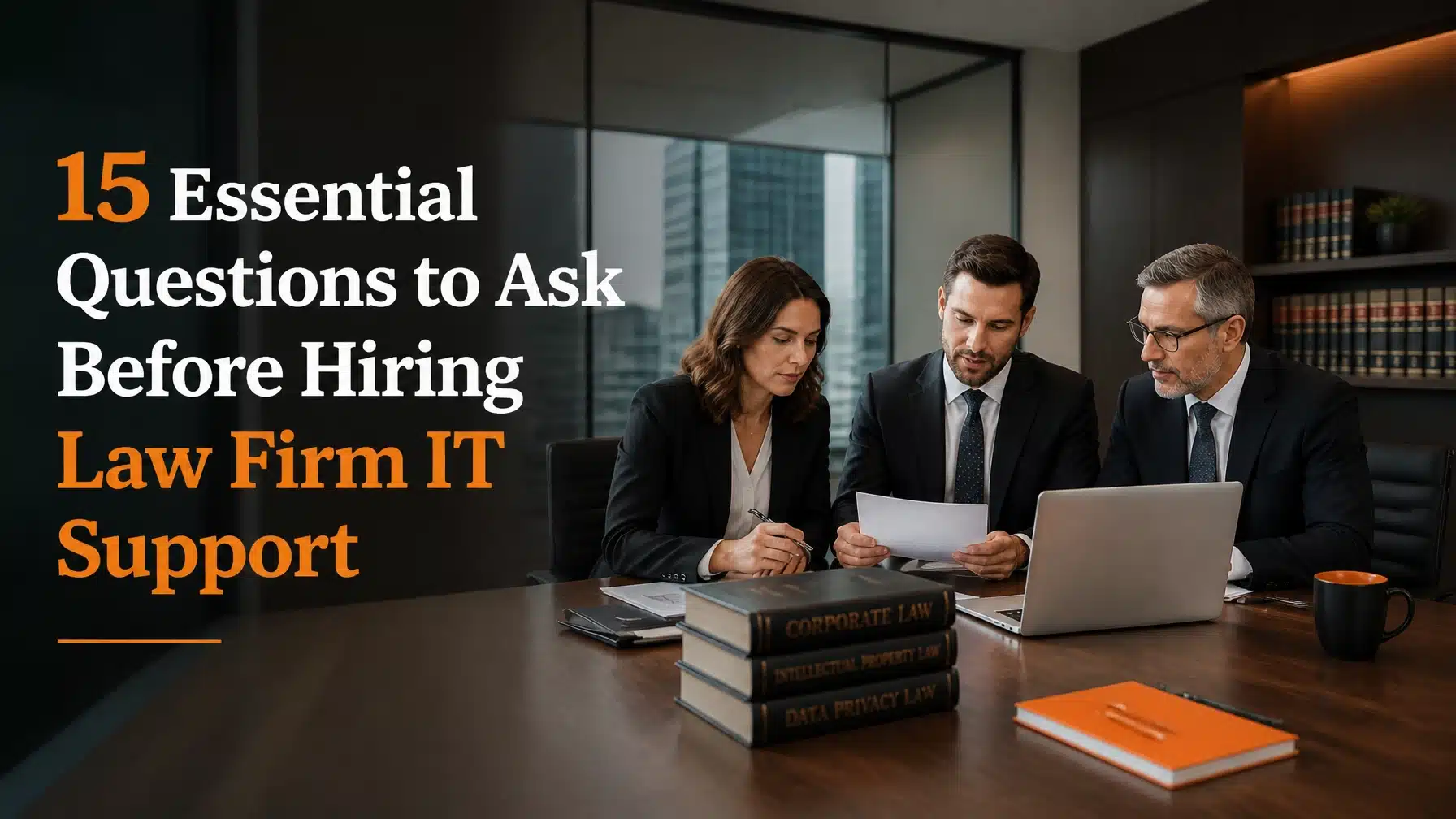
15 Essential Questions to Ask Before Hiring Law Firm IT Support
Updated: May 25, 2026
Selecting the right law firm IT support provider in 2026 is no longer a simple administrative task. It is a critical strategic decision that dictates your firm’s security posture, operational efficiency, and ability to leverage cutting edge technology like generative AI. Law firms handle the most sensitive data in the corporate world, making them prime targets for sophisticated cybercriminals. If your technology partner fails, your reputation and your client’s trust fail with them.
The stakes reached an all-time high this year. Recent data from Sikich indicates the average cost of a data breach for professional services firms has climbed to approximately $5.9 million. Furthermore, BakerHostetler reports that initial ransomware demands for law firms now average $4.2 million. When you consider that 90% of lawyers now utilize AI tools daily according to Wolters Kluwer, the complexity of managing a legal IT environment has grown exponentially. You need a partner who understands the intersection of billable hours and digital fortification.
This guide provides 15 essential questions to ask any prospective provider. These questions will help you separate standard “break-fix” shops from true strategic partners who can navigate the complexities of modern legal practice.
1. How do you secure our firm against the latest cyber threats?
Cybersecurity is the foundation of any reputable law firm IT support strategy. In 2026, threats have evolved beyond simple phishing emails. You must ask your provider about their implementation of Zero Trust architectures and Endpoint Detection and Response (EDR). EDR is a security solution that continuously monitors end-user devices to detect and respond to cyber threats like ransomware.
A qualified partner should also discuss SOC (Security Operations Center) monitoring. This involves a centralized team of security experts who monitor your systems 24/7/365 to catch anomalies before they become breaches. Given that 74% of breaches still involve human error or credential theft, your provider must demonstrate how they protect your firm’s “human firewall” through modern identity management.
2. Are you a certified Microsoft Security Solution Partner?
You should prioritize providers with the Microsoft Security Solution Partner designation. This certification proves the provider has deep technical capabilities and a proven track record of delivering security solutions within the Microsoft ecosystem. Since most law firms rely on Microsoft 365 and Azure, this expertise is non-negotiable.
Terminal B holds this status, ensuring we provide direct access to advanced Microsoft support and licensing optimizations. This partnership allows us to deploy sophisticated tools like Microsoft Purview for data governance and Microsoft Defender for integrated threat protection across your entire firm.
3. How will you help us manage and govern legal AI tools?
With 90% of lawyers using AI daily, your IT partner must do more than just “turn it on.” They must help you establish AI governance. This includes securing the data that feeds into large language models (LLMs) and ensuring that your firm’s intellectual property does not leak into public AI training sets.
Ask your prospective provider if they can implement Conditional Access policies. These policies act as digital gatekeepers, ensuring only authorized users on secure devices can access AI-driven research or drafting tools. Without proper oversight, AI adoption can create massive “shadow IT” risks where employees use unvetted tools that bypass your security controls.

4. What experience do you have with legal-specific applications?
Generic IT providers often struggle with the nuances of legal software. Your law firm IT support team must be intimately familiar with practice management systems like Clio, NetDocuments, iManage, or MyCase. They need to understand how these tools integrate with your document management and billing systems.
Ask for specific examples of how they have handled updates or migrations for these platforms. A botched update to a document management system can paralyze a firm for days. You need a team that speaks the language of “version control,” “metadata scrubbing,” and “matter-centric filing.”
5. What are your guaranteed response times for critical issues?
In the legal world, time is literally money. If a partner cannot access a filing minutes before a court deadline, the cost is immeasurable. You must review their Service Level Agreement (SLA). A standard SLA should define clear response times based on the severity of the issue.
At Terminal B, our Skytivity Secure Help Desk provides 24/7/365 support. We focus on rapid resolution rather than just acknowledging the ticket. Ask your provider: “What is your average time to resolution for P1 (critical) issues?” If they cannot provide a clear, data-backed answer, they are not ready for the demands of a high-stakes law firm.
6. How do you ensure compliance with HIPAA, NIST, or ITAR?
Many law firms handle discovery or healthcare records that fall under strict regulatory frameworks. Your IT partner must understand HIPAA (for medical records), NIST (for government contracting), or ITAR (for defense-related data). Compliance is not a “one and done” project; it is a continuous process.
Ask if they conduct regular compliance audits and if they provide the necessary documentation for your client audits. A proactive partner will help you implement MFA (Multi-Factor Authentication) across all systems to meet these regulatory requirements. MFA requires users to provide two or more verification factors to gain access to a resource, significantly reducing the risk of unauthorized access.
7. How do you protect our remote and hybrid workforce?
The “office” is now wherever your attorneys happen to be. This flexibility introduces significant risks. Your law firm IT support provider must secure every endpoint, whether it is a home laptop or a smartphone in a coffee shop.
Inquire about their use of Mobile Device Management (MDM) and Virtual Private Networks (VPNs). MDM allows your IT team to remotely wipe a lost phone or enforce encryption on personal devices used for work. We often recommend Azure Virtual Desktop to provide a secure, high-performance workspace that keeps firm data in the cloud rather than on local hard drives.
8. Can you explain your backup and disaster recovery process?
A backup is not a recovery plan. You need to know your Recovery Time Objective (RTO) and Recovery Point Objective (RPO). RTO is the maximum tolerable length of time that a computer, system, network, or application can be down after a failure. RPO is the maximum age of files that an IT system must recover from backup storage for normal operations to resume.
Your provider should use immutable backups, which are copies of data that cannot be changed or deleted even by a ransomware attacker who gains admin access. Ask them: “When was the last time you performed a successful test restore for a client?” If they don’t test their backups monthly, they are essentially useless.
9. How do you handle “Human Error” and security awareness?
Since 74% of breaches involve human elements, your IT partner must be an educator. They should provide regular security awareness training and simulated phishing attacks. This keeps your staff vigilant against PhaaS (Phishing as a Service) and social engineering.
We emphasize building a “security culture.” This means moving beyond boring annual videos to interactive, relevant training that addresses the specific threats lawyers face, such as fraudulent wire transfer requests or fake subpoena notifications.

10. What is your process for decommissioning old hardware and data?
Data liability does not end when a laptop dies. Law firms must follow strict rules for data destruction to maintain confidentiality. Your law firm IT support provider must have a documented process for disk wiping and physical destruction of old drives.
Ask for a certificate of destruction for every decommissioned device. This documentation is vital for your compliance records and protects you if an old device ever resurfaces with client data still on it.
11. How do you manage third-party vendor risks?
Your firm likely uses dozens of third-party apps. Each one is a potential backdoor into your network. A mature IT partner provides vendor management services. This involves vetting the security posture of your software vendors and ensuring their configurations meet your firm’s standards.
They should also help you implement DMARC (Domain-based Message Authentication, Reporting, and Conformance). DMARC prevents hackers from spoofing your firm’s email domain, which protects your reputation and prevents clients from receiving fraudulent emails that appear to be from your partners.
12. Do you provide proactive monitoring or just “break-fix” support?
The old model of waiting for something to break before fixing it is dead. You need a Skytivity model of proactive management. This includes 24/7 monitoring, automated patch management, and regular system health checks.
Proactive support identifies a failing hard drive or an unpatched vulnerability before it causes a system crash. This approach transforms IT from a reactive cost center into a stable foundation for your business growth.
13. How will you help us scale during a merger or acquisition?
Law firms are frequently in a state of flux. Whether you are adding a new practice group or merging with another firm, your IT must be agile. Ask how they handle tenant-to-tenant migrations in Microsoft 365.
A strategic partner provides IT Consulting to ensure your technology roadmap aligns with your firm’s long-term business goals. They should help you standardize your tech stack across all locations to simplify management and reduce costs.
14. What is your transparent pricing and ROI structure?
Avoid providers who hide costs in “extra” fees for every phone call or site visit. Look for a flat-fee model that aligns their interests with yours. When your IT works perfectly, they are more profitable. This creates a partnership based on uptime rather than billing for failure.
Ask for a clear breakdown of what is included in their Managed IT Services. Does it include Cybersecurity? Does it include executive-level strategic planning? Transparency here prevents budget surprises later in the year.
15. Can you provide real-world examples of legal client success?
Don’t settle for “we work with law firms.” Ask for specific scenarios. A provider should be able to describe how they helped a firm navigate a crisis or achieve a major technological leap.

Real-World Business Examples
Case Study A: The Boutique Firm Scaling with Cloud
A 15-person boutique litigation firm in Austin was struggling with an aging on-premise server that crashed during trial prep. Terminal B migrated their entire operation to a secure Microsoft 365 and Azure environment. By implementing Azure Virtual Desktop, the attorneys can now securely access their case files from the courtroom or their homes with zero lag. Their billable efficiency increased by 12% because they no longer fight with a slow VPN.
Case Study B: Navigating a Ransomware Threat
A mid-sized firm with 80 employees was targeted by a sophisticated ransomware attack. Because they had partnered with Terminal B for Managed IT Services, our SOC detected the lateral movement of the attacker within minutes. We immediately isolated the infected workstations and restored the affected files from immutable backups. The firm suffered zero data loss and was back to full operations in less than four hours, avoiding a potential $4 million ransom demand.
Conclusion: Securing Your Firm’s Future
Choosing your law firm IT support is one of the most consequential business decisions you will make this year. The complexity of 2026’s legal landscape requires more than a “tech guy.” You need a Microsoft Security Solution Partner who understands your ethical obligations and the technical threats you face daily.
By asking these 15 questions, you move beyond the surface level and find a partner who will protect your firm, empower your staff, and drive your ROI. Don’t wait for a $5.9 million breach to realize your current support is lacking.
Ready to fortify your firm?
Schedule a Professional Strategy Session with Terminal B today. Let’s discuss how our Skytivity model can simplify your IT and secure your client’s trust.
Frequently Asked Questions
Why is the Microsoft Security Solution Partner status important for law firms?
This designation ensures that your provider has the highest level of training and direct support from Microsoft. Since law firms rely on the Microsoft cloud for emails and documents, having a certified partner means faster resolution times and access to advanced security features like Zero Trust configurations and AI governance tools.
How does proactive IT support improve law firm profitability?
Proactive support, like our Skytivity model, prevents downtime before it happens. Every minute an attorney cannot bill due to technical issues is lost revenue. By automating updates and monitoring systems 24/7, we ensure your team stays productive, directly impacting your bottom line and increasing your ROI on technology investments.
What is the most common cybersecurity threat for law firms?
Credential theft and sophisticated phishing remain the top threats. Hackers use social engineering to trick staff into revealing passwords or authorizing fraudulent wire transfers. Combining MFA, DMARC, and regular security awareness training is the most effective way to mitigate these “human error” risks.
Can managed IT services help with legal compliance?
Yes. A professional IT partner ensures your infrastructure meets the standards of HIPAA, NIST, and other regulations. They provide the necessary encryption, access controls, and audit trails required to pass client-driven security audits and maintain professional standing.
Author Bio: Greg Bibeau
Greg Bibeau is the CEO and founder of Terminal B, a premier Managed IT Services provider based in Austin, Texas. With over three decades of experience in the MSP industry, Greg has helped hundreds of organizations simplify their technology and achieve secure, scalable growth. He is a passionate advocate for proactive IT management and specializes in helping highly regulated industries, such as legal and healthcare, navigate the complexities of modern cybersecurity.
Related Posts