For small and mid-sized businesses (SMBs), managing devices, users, and security can quickly become overwhelming—especially…
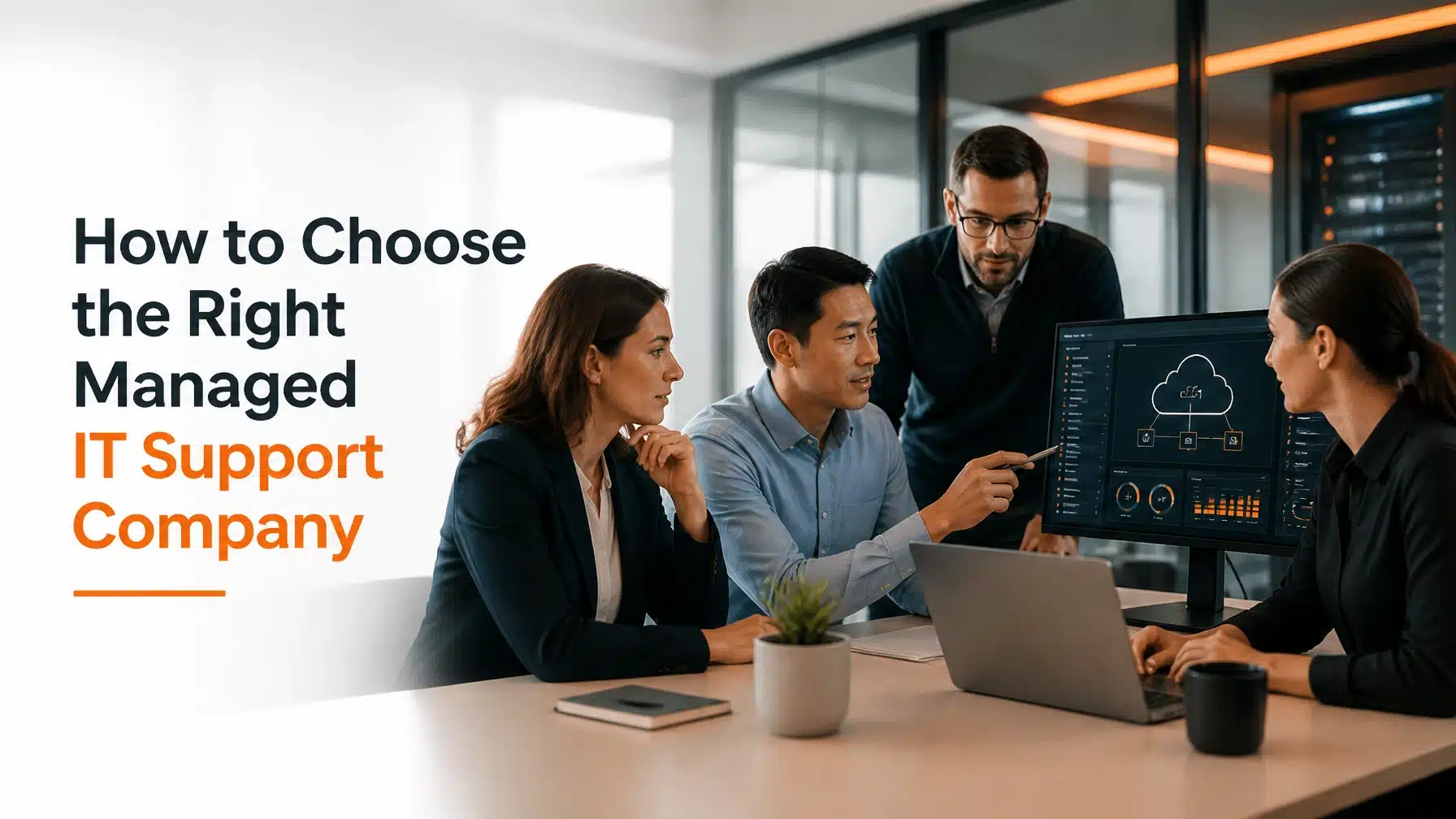
How to Choose the Right Managed IT Support Company: The Ultimate Modern Guide
Updated: May 29, 2026
Technology serves as the backbone of every successful modern organization. However, many business leaders still treat IT as a secondary concern until something breaks. Currently, the stakes of a technology failure are higher than ever before. Research shows that the average cost of downtime for SMBs is approximately $8,662 per hour. Consequently, a single afternoon of system issues can erase a week of profit. You need a partner who prevents these disasters rather than just reacting to them.
Choosing the right managed IT support company is no longer a simple procurement task. It is a strategic decision that determines your organization’s resilience and growth potential. Modern IT management focuses on business outcomes and proactive risk mitigation. This guide provides a comprehensive framework to help you navigate the complex landscape of managed services. You will learn how to identify a partner who aligns with your long-term goals and secures your digital assets.
What is Managed IT Support in the AI Era?
Managed IT support has evolved far beyond the traditional “help desk” model. Today, a managed IT services provider acts as a strategic extension of your business. This partnership involves a proactive, subscription-based approach to technology management. We focus on continuous monitoring, maintenance, and security rather than fixing hardware after it fails.
In the current landscape, AI plays a pivotal role in how we deliver support. Our team uses AI-driven tools to predict potential failures before they impact your operations. This shift from reactive to predictive maintenance allows us to maintain high levels of system availability. Furthermore, the modern workplace requires support for both on-site and remote environments. We call this our Skytivity model. It provides 24/7/365 support for Windows and Mac users to ensure your team remains productive at all times.
The Shift to Business Outcomes
Modern organizations do not just need “fast computers.” They need technology that drives revenue and improves employee retention. Therefore, a top-tier provider prioritizes IT consulting services to align systems with your specific business objectives. We help you transition from “fixing things” to achieving measurable growth.
The Talent Gap: Why Hiring Internally is Getting Harder
Many organizations initially try to manage their technology in-house. However, finding and keeping qualified IT professionals has become a significant challenge. Recent data reveals that 61% of SMBs struggle to hire qualified IT staff internally. This talent gap often leads to overworked employees and critical security oversights.
Managed services offer a more sustainable and cost-effective alternative. When you partner with a Microsoft Security Solution Partner, you gain access to an entire team of specialists. You do not have to worry about a single person’s vacation or sick leave disrupting your operations. Moreover, the cost of hiring a full-time senior architect often exceeds the budget of a mid-sized firm. An MSP provides that level of expertise at a fraction of the cost.

Choosing a Partner: Local Accountability vs. Private Equity Scale
The MSP industry has seen significant consolidation recently. Many smaller firms have been purchased by large, private-equity-backed corporations. These giant firms often prioritize volume and standardized profit margins over personalized service. They might treat your organization as a ticket number rather than a partner.
In contrast, Terminal B remains a locally owned and operated partner in Texas. We believe that IT support in Austin requires a personal touch and deep community roots. Local accountability ensures that our leaders are directly invested in your success. You get the stability of a mature company combined with the responsiveness of a neighbor. We focus on value and long-term relationships rather than meeting quarterly quotas for distant investors.
The Benefits of Vertical Expertise
Different industries face unique technological hurdles. For example, healthcare IT solutions must comply with strict HIPAA regulations. Similarly, financial services and manufacturing require high levels of precision and NIST compliance. You should choose a partner with deep experience in your specific sector. This expertise ensures they understand your regulatory environment and operational workflows from day one.
5 Essential Questions for Any MSP Candidate
Before signing a contract, you must vet your potential partner thoroughly. Use these questions to separate the experts from the average providers.
- Are you a Microsoft Security Solution Partner? This designation proves the firm has a direct relationship with Microsoft. It ensures faster support and direct access to the latest cloud resources.
- How do you handle compliance and regulatory requirements? Your partner should offer robust IT compliance services. Ask about their experience with HIPAA, NIST, or ITAR if your industry requires it.
- What is your approach to Zero Trust architecture? Modern security assumes that threats can come from anywhere. A reliable provider must implement Zero Trust principles to protect your data.
- Can you provide 24/7/365 support for my entire team? Technology issues do not wait for business hours. Ensure your partner offers round-the-clock help desk services.
- What does your proactive maintenance schedule look like? Ask for a specific list of tasks they perform weekly and monthly. They should demonstrate how they prevent issues before they occur.
Cybersecurity as a Baseline, Not an Add-on
Cybersecurity is no longer a luxury for large corporations. Today, 43% of cyberattacks target small to mid-sized businesses. These organizations often have fewer defenses, making them easy targets for hackers. Therefore, you must choose a partner who integrates security into every layer of their service.
We treat security as a baseline requirement. Our standard managed services include advanced Endpoint Detection and Response (EDR) and automated patch management. We also implement Multi-Factor Authentication (MFA) and provide security awareness training for your employees. Educating your staff is crucial because human error remains a leading cause of data breaches. A culture of security protects your organization more effectively than software alone.

Implementing Zero Trust
Zero Trust is a modern security framework. It requires every user and device to be verified before accessing any part of your network. We move away from the old “castle and moat” model. This strategy ensures that even if one account is compromised, the rest of your data remains safe. We recommend this approach for all managed service provider Texas clients to combat modern threats.
Calculating ROI: The Move from Break-Fix to Flat-Fee
Traditional “break-fix” IT support models are inherently flawed. In those models, your IT provider only makes money when your technology fails. This creates a misalignment of goals. Conversely, a managed services model uses a flat-fee, per-user subscription. This aligns our incentives with yours. We both want your systems to run perfectly.
The return on investment (ROI) for managed IT is clear. Current studies show that managed IT can reduce unplanned downtime by up to 45%. When you reduce downtime, you increase productivity and revenue. Furthermore, about 58% of SMBs now use MSPs to handle their technology. This adoption rate reflects the growing understanding that managed services are a business necessity. You gain predictable monthly costs and a much higher level of service than a reactive model provides.
Conclusion: Aligning IT with Business Growth
Choosing the right managed IT support company is a journey toward stability and growth. You need more than just a technician who answers the phone. You deserve a strategic partner who understands your vision and protects your future. By focusing on proactive management, local accountability, and advanced security, you position your organization for long-term success.
Technology should empower your team, not hold them back. Are you ready to see how professional IT management can transform your operations? Let us help you align your technology with your business goals.
Ready to simplify your IT and secure your organization? Schedule a strategy session with Terminal B today.
Frequently Asked Questions
Why should I choose a locally-owned MSP over a national provider?
Locally-owned firms like Terminal B provide higher levels of accountability and personalized service. We understand the specific business climate in Texas. National providers often struggle with high staff turnover and a “one-size-fits-all” approach that may not fit your unique needs.
What is included in a typical managed IT services agreement?
A comprehensive agreement includes 24/7 help desk support, proactive system monitoring, and layered cybersecurity. It also covers cloud management, data backups, and strategic IT consulting. We provide all these services for a predictable monthly fee.
How does a managed IT support company improve cybersecurity?
We implement a multi-layered security strategy. This includes EDR, MFA, and automated software updates. We also monitor your network 24/7 for suspicious activity. Our team provides security training to your employees to help them recognize phishing attempts.
Can managed IT services help with regulatory compliance?
Yes. We specialize in helping organizations meet complex standards like HIPAA, NIST, and CMMC. We perform regular audits and maintain documentation to ensure your technology meets all legal and industry requirements.
What is the typical onboarding process for a new IT partner?
Onboarding usually begins with a deep audit of your current systems. We identify immediate risks and create a roadmap for improvements. Then, we install our monitoring and security tools. Our team works closely with yours to ensure a smooth transition with minimal disruption.
About the Author
Greg Bibeau is the CEO of Terminal B, an Austin-based IT management firm. With over 30 years of experience, he helps organizations leverage technology as a competitive advantage. Greg is passionate about simplifying complex IT challenges and building long-term partnerships with business leaders across Texas.
Related Posts