Construction companies face IT challenges in construction industry because their work happens across offices, jobsites,…
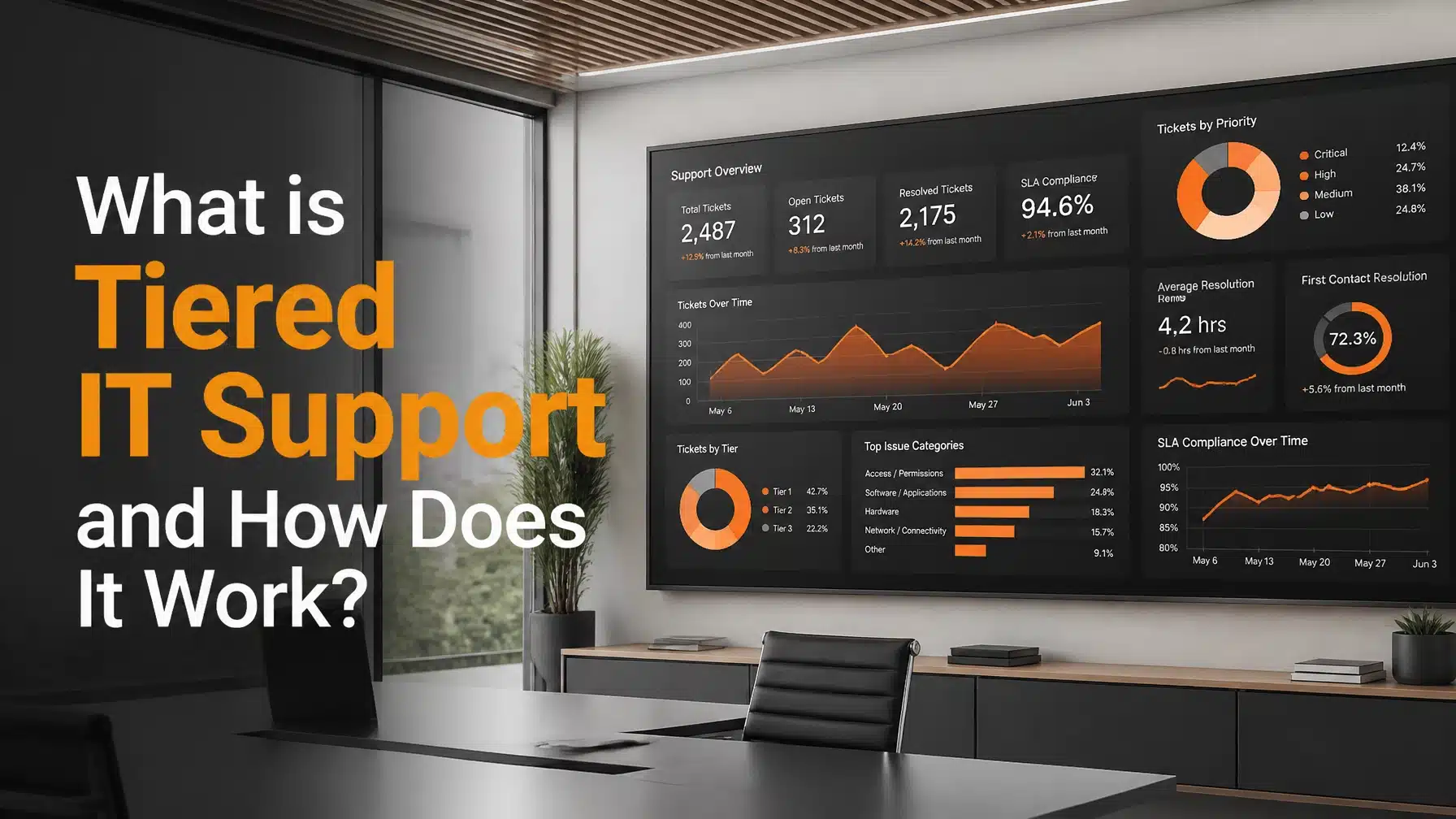
What is Tiered IT Support and How Does It Work?
Modern organizations deal with many IT issues every day. Some are simple, like password resets. Others are more serious, like cloud outages or server problems. A tiered IT support model gives your organization a clear way to send each issue to the right level of support. As a result, senior engineers can stay focused on high-value work while routine issues get fixed quickly.
By organizing support into levels, usually L0 through L4, you create a clear path for every request. This structure improves efficiency and reduces downtime across your organization. Furthermore, it helps your IT operations grow with your business. Instead of depending on one generalist, you use a support team with defined roles, from frontline troubleshooting to vendor escalation.
Recent data shows that L1 agents typically resolve between 60% and 70% of tickets within 15 minutes, according to Atera. Consequently, a well-built tiered IT support model keeps senior engineers from getting pulled into basic tasks. This matters because IT environments are becoming more complex. In fact, organizations can save an average of 15% by moving from a one-person IT setup to a structured support model.
The Core Levels of a Tiered IT Support Model
A strong IT strategy depends on sending problems to the right team. Each level has a clear role and set of tasks. When your organization uses this framework, employees know what to expect and get more consistent support.
Tier 0 (L0): Self-Service and AI Automation
Tier 0 is the first stop in a modern tiered IT support model. This level uses self-service tools so users can solve simple problems on their own. Common examples include FAQs, knowledge bases, and automated chat tools.
In most organizations, Tier 0 is the lowest-cost layer of support. It handles common, simple issues like software setup steps or basic account changes. Automated portals also provide 24/7 help without adding payroll cost. As a result, your IT team can focus on more urgent technical work while users get answers right away.
Tier 1 (L1): Frontline Help Desk
Tier 1 is the first human layer of support for your employees. These agents handle routine issues and perform the first review of each request. They often fix password resets, basic software errors, and printer problems.
L1 agents use set processes and the internal knowledge base to solve issues quickly. Their main goal is a high first-contact resolution rate. However, if a problem is too complex, they document it and pass it to the next level. This helps ensure that no request gets lost or delayed.

Tier 2 (L2): Technical Support Specialists
When an issue needs deeper review, it moves to Tier 2. These specialists have more experience and wider system access than the frontline help desk. They handle problems such as software bugs, network failures, and hardware diagnostics.
L2 technicians often use remote sessions to work directly in the user’s environment. They review logs and settings to find the root cause of the issue. Moreover, their deeper knowledge helps them solve problems that fall outside normal L1 steps. Their work is especially important in regulated fields like healthcare and financial services.
Tier 3 (L3): Specialized Expert Engineering
Tier 3 includes highly skilled engineers and architects. These experts focus on root-cause analysis and complex infrastructure work. They handle high-impact issues that could disrupt your business.
L3 engineers manage back-end systems such as server settings and cloud architecture. They also support proactive maintenance and system design. For example, if your organization faces a recurring database failure, the Tier 3 team investigates the deeper design issue. Consequently, their expertise helps keep your systems stable and secure.

Tier 4 (L4): External Vendor and Manufacturer Escalation
The final level of the tiered IT support model uses external resources. Tier 4 includes support from hardware makers or software vendors. You reach this level when a problem comes from a bug or limit in a third-party product that your internal team cannot fix.
For example, if a key Microsoft 365 feature stops working because of a larger outage, your IT partner coordinates with Microsoft experts. As a Microsoft Security Solution Partner, Terminal B manages these relationships directly. This tier ensures that even rare technical problems get attention from the people who built the product.
Why Your Organization Needs a Tiered IT Support Model
Using a structured support hierarchy is not just about organizing tickets. It is a business decision that protects your bottom line and improves employee morale. Without a clear model, your IT team can become a bottleneck that slows down the company.
Faster Resolution and Reduced Downtime
The most immediate benefit is faster resolution. When L1 agents quickly fix 70% of issues, your employees get back to work sooner. They do not need to wait for a senior engineer to finish a major server project just to reset a password.
Furthermore, a structured model reduces overall downtime. Clear escalation paths move difficult problems to experts without delay. As a result, your organization protects revenue, productivity, and customer satisfaction.
Efficient Resource Allocation
A tiered IT support model makes sure you use the right level of expertise for each task. You do not want a senior architect spending hours on basic help desk tickets. By routing simple requests to frontline staff, you free senior team members for planning and improvement work.
This approach helps your IT leaders focus on digital transformation and cybersecurity improvements. Consequently, technology becomes a growth driver instead of only a cost center. Proper resource use is one of the main reasons why outsourced IT support is the way to go for mid-sized firms.
Scalability and Growth
As your organization adds more employees, the number of IT requests will increase. A tiered model lets you grow frontline support without hiring more high-level engineers right away. You can expand the help desk while keeping your core infrastructure team lean.
Moreover, this structure creates a clear career path for IT professionals. L1 agents can learn from L2 specialists and build new skills over time. As a result, your organization gains stronger system knowledge and better employee retention in technical roles.

Modern Trends: AI Triage and Remote-First Support
IT support is changing quickly. Advances in AI and remote tools are reshaping how the tiered IT support model works. Organizations that ignore these changes risk falling behind in both efficiency and security.
Agentic AI and Intelligent Routing
One of the biggest shifts is the rise of Agentic AI. These systems do more than answer basic questions. They can also classify and route tickets with high accuracy. AI can review the language and technical details in a request to decide if it needs immediate L2 escalation.
This automated triage reduces handoff time between tiers. Documentation is also becoming more automated, which gives L3 engineers the context they need when a ticket reaches them. Furthermore, using AI at the L0 and L1 levels reduces the manual work needed to manage a busy help desk.
The Importance of Secure Remote Support
The modern workforce often works across many locations. As a result, Tier 1 and Tier 2 support must be remote-first. However, this shift also requires strong security controls so remote sessions do not create new risk.
Current cybersecurity standards stress the need for secure access. In fact, 98% of all cyber insurance claims now come from SMEs, according to NetDiligence. A structured support model builds secure remote tools and multi-factor authentication into every interaction. Consequently, your organization is better protected from unauthorized access during support sessions.
How Terminal B Implements Tiered Support with the Skytivity Model
Terminal B does more than provide IT support. We offer a complete management strategy called Skytivity. Our approach builds on the traditional tiered IT support model and adapts it for modern, security-focused organizations.
Skytivity Secure Help Desk
Our Skytivity Secure Help Desk serves as your L1 and L2 frontline. We provide 24/7/365 technical support for both Windows and Mac environments. Our goal is to keep your employees productive by resolving issues quickly and securely.
We handle everything from standard troubleshooting to complex access requests. Because we are a Microsoft Security Solution Partner, our team has direct access to current tools and training. As a result, we can often resolve issues faster than a small internal team working alone.
Skytivity Sys Admin and Engineering
For Tier 3 and Tier 4 needs, our Skytivity Sys Admin services provide deep technical expertise. We manage your back-end infrastructure, maintain complex systems, and optimize your cloud environment. We act as your engineering team and perform the root-cause analysis that helps prevent repeat issues.
Additionally, our Virtual CIO (vCIO) role provides strategic guidance. We help you align IT investments with long-term business goals. This includes planning for growth and supporting compliance with industry regulations like HIPAA or NIST.

By partnering with Terminal B, you gain access to a mature tiered IT support model without the cost and effort of building it yourself. We provide the structure, expertise, and security your organization needs to operate with confidence.
Frequently Asked Questions
What is the main difference between Tier 1 and Tier 2 IT support?
Tier 1 is the frontline help desk. It handles common issues like password resets and basic troubleshooting. Tier 2 includes more experienced specialists who investigate system errors, network issues, and hardware problems. They also usually have more access to fix complex settings.
How does a tiered IT support model save money?
A tiered model saves money by sending simple, frequent issues to lower-cost frontline staff or self-service tools. This keeps senior engineers focused on advanced work. Additionally, it reduces downtime, which protects productivity and revenue.
When should an IT issue be escalated to Tier 4?
An issue should move to Tier 4 when it involves a bug or product limit that internal teams or an MSP cannot fix. This usually means working with the hardware maker or software vendor for a product-specific solution.
Can small businesses benefit from a tiered IT support model?
Yes. Small businesses often benefit the most when they outsource to an MSP that uses this model. They gain access to help desk support, senior engineering, and strategic guidance without building a full in-house team. As a result, they can scale support more easily as they grow.
Is your current IT support structure slowing you down? Contact Terminal B today to schedule a strategy session and discover how our Skytivity model can streamline your operations.
Related Posts