Choosing between Microsoft 365 and Google Workspace often feels like a permanent fork in the…
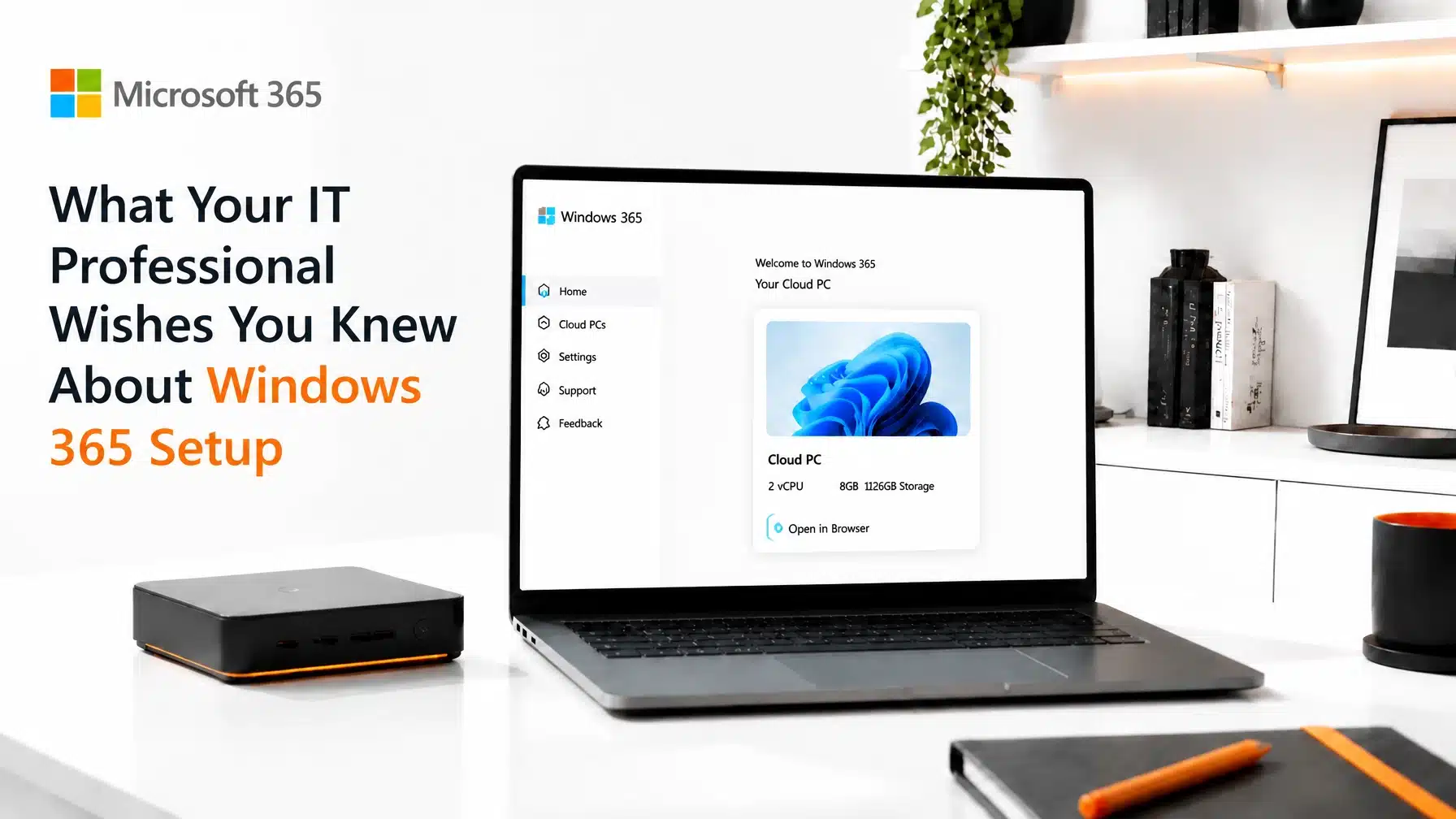
What your IT professional wishes you knew about Windows 365 setup
Updated: 7/17/2026
Many business owners feel a sense of confusion when they first encounter the term “Windows 365.” In recent years, Microsoft has expanded its ecosystem significantly. This growth often leads to a common misunderstanding between standard productivity software and the revolutionary “Cloud PC.” At Terminal B, we see this confusion daily. Business leaders often ask why they need a Windows 365 setup if they already pay for Microsoft 365 apps.
The answer lies in the fundamental difference between software and hardware. While Microsoft 365 provides the tools you use, Windows 365 provides the computer itself. It is a persistent, personal desktop that lives entirely in the cloud. Recent data shows that cloud-based desktop adoption has surged, with Microsoft reporting a significant increase in commercial cloud revenue as organizations move away from traditional on-premises infrastructure. Consequently, understanding how to configure this environment correctly is vital for modern business stability.
For organizations in Central Texas, especially those in regulated industries like healthcare and finance, the Cloud PC offers a level of flexibility that physical hardware cannot match. However, a successful deployment requires more than just a license. It requires a strategic approach to security, networking, and user experience. This guide will clarify the modern landscape of Windows 365 and share the “secrets” your IT team wants you to know.
The Core Distinction: Microsoft 365 vs. Windows 365
The primary hurdle in any Windows 365 setup is distinguishing it from Microsoft 365. You likely use Microsoft 365 every day for email, spreadsheets, and collaborative documents. These are applications. You install them on a physical device, such as a laptop or a desktop sitting under your desk. If that laptop breaks or stays at the office, your work environment stays with it.
Windows 365 is different. It is a complete Windows operating system hosted in the Microsoft cloud. It includes your settings, your desktop background, and your specialized line-of-business applications. Because the OS is in the cloud, you can access it from any device with an internet connection. Whether you are using a Mac at home or a tablet in a coffee shop, your desktop remains exactly as you left it.
Moreover, the management of these systems is streamlined. While Windows 365 vs Azure Virtual Desktop is a common comparison, Windows 365 wins on simplicity. It provides a fixed-price, predictable model. IT teams can provision a new machine in minutes rather than hours. This speed is a game-changer for growing teams in Austin and beyond. You get the power of a high-end workstation without the capital expenditure of physical hardware.
5 Setup Secrets Your IT Team Wants You to Understand
A smooth transition to the cloud depends on several technical pillars. Your IT professional likely spends hours fine-tuning these settings behind the scenes. Understanding these five secrets will help you align your business goals with your technology strategy.
Security Hardening: No More Local Admin Rights
In the current security climate, local administrator rights are a massive liability. In the past, users often demanded admin access to install their own software. However, modern threats like ransomware thrive when users have elevated permissions. Current Microsoft security defaults now disable the built-in Administrator account by default.
Your IT team wants you to embrace this restriction. By limiting permissions, we create a Zero Trust environment. This ensures that even if a user clicks a malicious link, the damage remains contained. Consequently, we use Microsoft Intune to push approved applications to your Cloud PC automatically. This approach keeps your environment clean, fast, and compliant with standards like HIPAA and ITAR.
Connectivity is Your New “Motherboard”
In a traditional office, the speed of your motherboard and RAM determines your productivity. In a Windows 365 setup, your network connection takes over that role. However, bandwidth is not the most important factor. You do not need a massive fiber line to run a Cloud PC, but you do need low latency.
Latency is the “lag” or delay between your mouse click and the action appearing on the screen. If your latency is high, the experience feels sluggish. Your IT team monitors these metrics closely. We recommend a wired connection whenever possible. If you must use Wi-Fi, ensure you are on a modern, high-speed mesh network. As a result of prioritizing latency, your team will enjoy a seamless experience that feels like a local machine.
The Windows App is Your New Front Door
Gone are the days of searching for the “Remote Desktop” icon. Microsoft has introduced the Windows App as the unified access point for all cloud resources. This app provides a single interface for Windows 365, Azure Virtual Desktop, and even Dev Box environments.
The Windows App simplifies the user experience significantly. It allows for cross-device access with a consistent look and feel. You can pin your Cloud PC to the taskbar or start menu for instant access. This unified approach reduces the training burden on your staff. When everyone knows where to go to find their work, productivity naturally increases.
Windows 365 Boot and Switch
One of the most impressive recent features is Windows 365 Boot. This allows a physical device to boot directly into your Cloud PC. Instead of logging into a local laptop and then launching a cloud session, the cloud session is the login. This is perfect for shared workstations in healthcare clinics or manufacturing floors.
Additionally, Windows 365 Switch allows you to move between a local Windows desktop and a Cloud PC with a simple keyboard shortcut or swipe. This hybrid workflow is ideal for power users who might need local hardware for video editing but want their cloud environment for secure corporate data. These features bridge the gap between physical and virtual worlds more effectively than ever before.
Provisioning Policies: Why “The First Policy Wins” Matters
Behind the curtain of your Windows 365 setup lies a system of “Provisioning Policies.” These policies tell Microsoft how to build your Cloud PC. They define the region, the network, and the image used. A critical rule in this system is that “the first policy wins.”
If a user is accidentally assigned to two different groups with conflicting policies, the system will apply the first one it finds. This can lead to unexpected results, such as a user in Texas being provisioned on a server in Europe. Your IT team carefully maps out these groups to ensure every employee gets the right resources. This organized structure is what allows us to maintain a 99.9% uptime SLA backed by Microsoft.
The Hardware Evolution: Introducing the Windows 365 Link
For years, the dream was a “stateless” office. We wanted a workplace where no data lived on local hard drives. The Windows 365 Link makes this a reality. This is a small, purpose-built hardware device designed exclusively for Cloud PCs. It has no local storage and a highly stripped-down operating system.
The Windows 365 Link is the ultimate security tool for high-risk industries. If a thief steals the device, they find nothing. There are no files to recover and no passwords stored in the memory. It boots in seconds and connects directly to the Windows 365 service. For businesses in Central Texas managing sensitive financial data or patient records, this hardware evolution represents the pinnacle of modern IT management.
Why Central Texas Businesses Choose Terminal B for Cloud PC Deployment
Implementing a Windows 365 setup is a strategic move that requires expert guidance. As a Microsoft Security Solution Partner, Terminal B offers a level of expertise that goes beyond basic troubleshooting. We understand the nuances of the Microsoft cloud ecosystem and how to tailor it to your specific industry needs.
Our Skytivity model ensures your IT environment remains proactive rather than reactive. We do not just wait for things to break. Instead, we monitor your Cloud PC performance, security baselines, and connectivity metrics 24/7. This proactive approach is essential for businesses in biotech, construction, and venture capital where downtime is not an option.
We specialize in helping organizations transition from messy, unmanaged environments to streamlined, secure cloud infrastructures. Whether you are navigating the complexities of Windows 365 vs Azure Virtual Desktop or looking to deploy the latest stateless hardware, we are your local partner in Texas. We combine global technology standards with the personalized service of a locally-owned firm.
> “The shift to Cloud PCs isn’t just about remote work; it’s about building a resilient, scalable foundation that can withstand any hardware failure or security threat.” , Greg Bibeau, CEO of Terminal B
Frequently Asked Questions
What is the main difference between Windows 365 and Azure Virtual Desktop?
The primary difference is management and pricing. Windows 365 is a SaaS (Software as a Service) product with a fixed monthly price per user. It is easier to manage and designed for persistent, one-to-one desktops. Azure Virtual Desktop is a PaaS (Platform as a Service) offering that is consumption-based. It offers more customization and multi-session capabilities but requires more advanced IT expertise to manage.
Can I run specialized software like QuickBooks or CAD on a Cloud PC?
Yes, you can run almost any Windows-compatible software on a Cloud PC. During your Windows 365 setup, we select the appropriate hardware specifications (vCPU and RAM) to match your workload. For resource-intensive applications like CAD, we can provision GPU-enabled Cloud PCs that provide the necessary power for 3D rendering and complex calculations.
Is my data safe if I lose my laptop while using Windows 365?
Your data is actually safer with Windows 365. Because the operating system and all your files live in the Microsoft cloud, nothing is stored on the physical laptop’s hard drive. If you lose your device, you simply log into your Cloud PC from a different machine. Your session will be exactly where you left it, and your data remains protected by enterprise-grade encryption and MFA.
Does Windows 365 work on a Mac or iPad?
Absolutely. One of the greatest benefits of the Cloud PC is its cross-platform compatibility. You can use the Windows App on macOS, iOS, Android, and even through a web browser on Linux. This allows your team to use the hardware they prefer while maintaining a secure and standardized corporate Windows environment.
Are you ready to simplify your IT infrastructure?
Moving to a Cloud PC environment can reduce your hardware costs and significantly improve your security posture. At Terminal B, we help you navigate the complexities of cloud deployment so you can focus on your core business. Contact us today for a strategy session and discover how Windows 365 can transform your organization.
About Greg Bibeau
Greg Bibeau is the Founder and CEO of Terminal B, the premiere MSP in Central Texas. With 3 decades of experience in the IT industry, Greg has guided hundreds of businesses through the evolution of cloud computing and cybersecurity. He is passionate about using technology to drive business growth and creating secure, efficient environments for mid-sized organizations.
Related Posts